How to Stop Smoke and Tadka Smells in an Open Concept Indian Kitchen
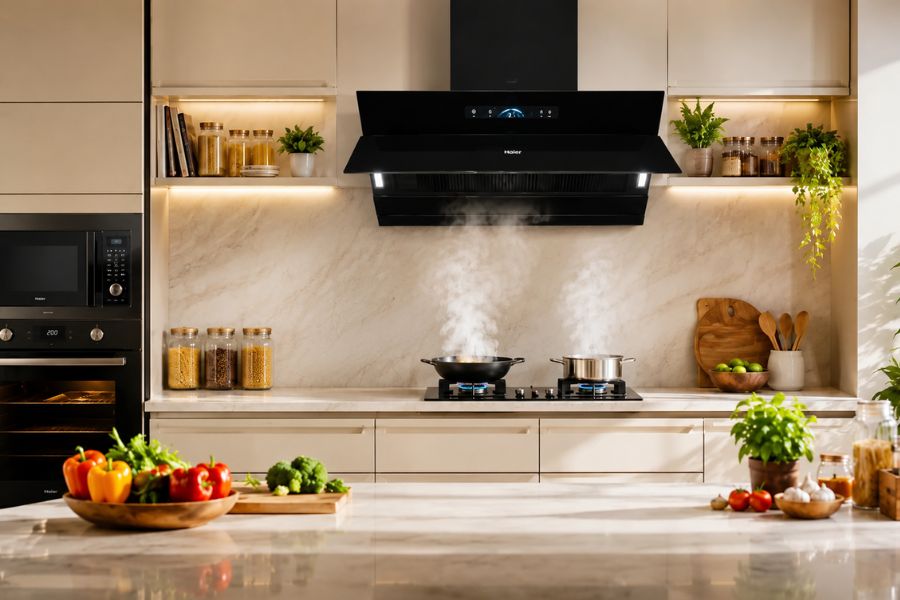
Walk into any interior design showroom or scroll through Pinterest for five minutes, and you'll see the same trend everywhere: open-concept living. Knocking down the wall between the kitchen and the living room instantly makes a home feel bigger, brighter, and more social. It's no surprise that open concept kitchen Indian homes are now a top request from homeowners across Gurgaon, Delhi NCR, and every major metro.
But here's the catch that doesn't show up in the glossy photos — Indian cooking is not built for open floor plans. Between mustard seeds crackling in hot oil, a tadka that hits the pan like a small explosion, and slow-simmered curries that release steam for hours, our cuisine is aromatic, oil-heavy, and smoke-generating in a way that Western-style open kitchens were never designed to handle.
So does that mean you have to choose between a beautiful, connected home and a kitchen that actually works for dal, sabzi, and deep frying? Not anymore. With the right open kitchen design for Indian cooking, smart ventilation, and a few layout tricks, you can have both. This guide breaks down exactly how.
What Makes Indian Cooking Different From a Standard Open-Concept Kitchen?
Most open-kitchen inspiration comes from international design, where cooking typically means light sautéing, baking, or reheating — low-oil, low-smoke, low-odor activities. Indian cooking, on the other hand, regularly involves high-heat tempering, deep frying, and slow-cooked, oil-rich gravies that release steam and grease over long cooking times. This is precisely why the debate around open vs closed kitchen for Indian homes is so much more nuanced here than in Western design conversations — it's a functional choice, not just an aesthetic one.
The Four Cooking Habits That Drive Odor in Indian Homes
- High-heat tempering (tadka) with mustard seeds, curry leaves, hing, and dried red chillies
- Deep frying for pakoras, puris, and snacks
- Slow-cooked, oil-rich gravies that release steam and grease particles over long cooking times
- Strong spice profiles — turmeric, garam masala, and asafoetida — that cling to soft furnishings, curtains, and upholstery
Is an Open Kitchen a Good Idea for Heavy Indian Cooking?
If you or your family cooks elaborate meals daily — think multiple sabzis, dal, rotis, and the occasional deep-fried snack — a fully open kitchen with no separation at all can become a genuine problem. Smoke alarms trigger unnecessarily, sofas and curtains absorb odors, and the living room can smell like the kitchen for hours after cooking. The real answer lies in a spectrum of design choices, not a binary yes-or-no.
Semi-Open Layouts: The Middle Ground Most Indian Homes Choose
For most Indian households, a semi open kitchen design India approach — combining an open layout with strategic ventilation and partial visual separation — offers the best of both worlds: the social, spacious feel of an open plan, with enough containment to manage smoke and smell.
What Chimney Suction Power Do You Need for an Open Kitchen?
Before you even think about glass partitions or breakfast counters, get the exhaust system right — no layout trick compensates for weak ventilation. For a closed kitchen, a chimney with 1000–1200 m³/hr suction is usually sufficient. For an open kitchen design for Indian cooking, where smoke and odor have an entire living-dining area to disperse into before being pulled out, you need considerably more power.
Recommended Suction Power by Kitchen Size (m³/hr)
|
Open Kitchen Size |
Minimum Suction Power |
|
Compact open kitchens (under 100 sq. ft. connected area) |
1200 m³/hr |
|
Medium open-plan homes |
1400–1600 m³/hr |
|
Large open living-kitchen-dining spaces, or heavy daily frying/tempering |
1600–1800+ m³/hr, ideally with auto-clean |
Suction power isn't the only spec that matters — noise levels (look for chimneys under 58–60 dB), filter type, and duct length all affect real-world performance. A high-suction chimney connected to a long, bent duct run will perform far worse than the rating suggests.
Also read: Modular Kitchen Trends 2026: AI, Colors, and Smart Upgrades
Five Non-Negotiable Features of the Best Chimney for Indian Open Kitchens
- High suction power chimney India models rated 1400 m³/hr or above for open layouts
- Auto-clean technology — Indian cooking generates heavy grease, and manual cleaning becomes a chore fast
- Baffle filters over mesh filters — baffle filters handle oil-heavy Indian cooking far better and need less frequent cleaning
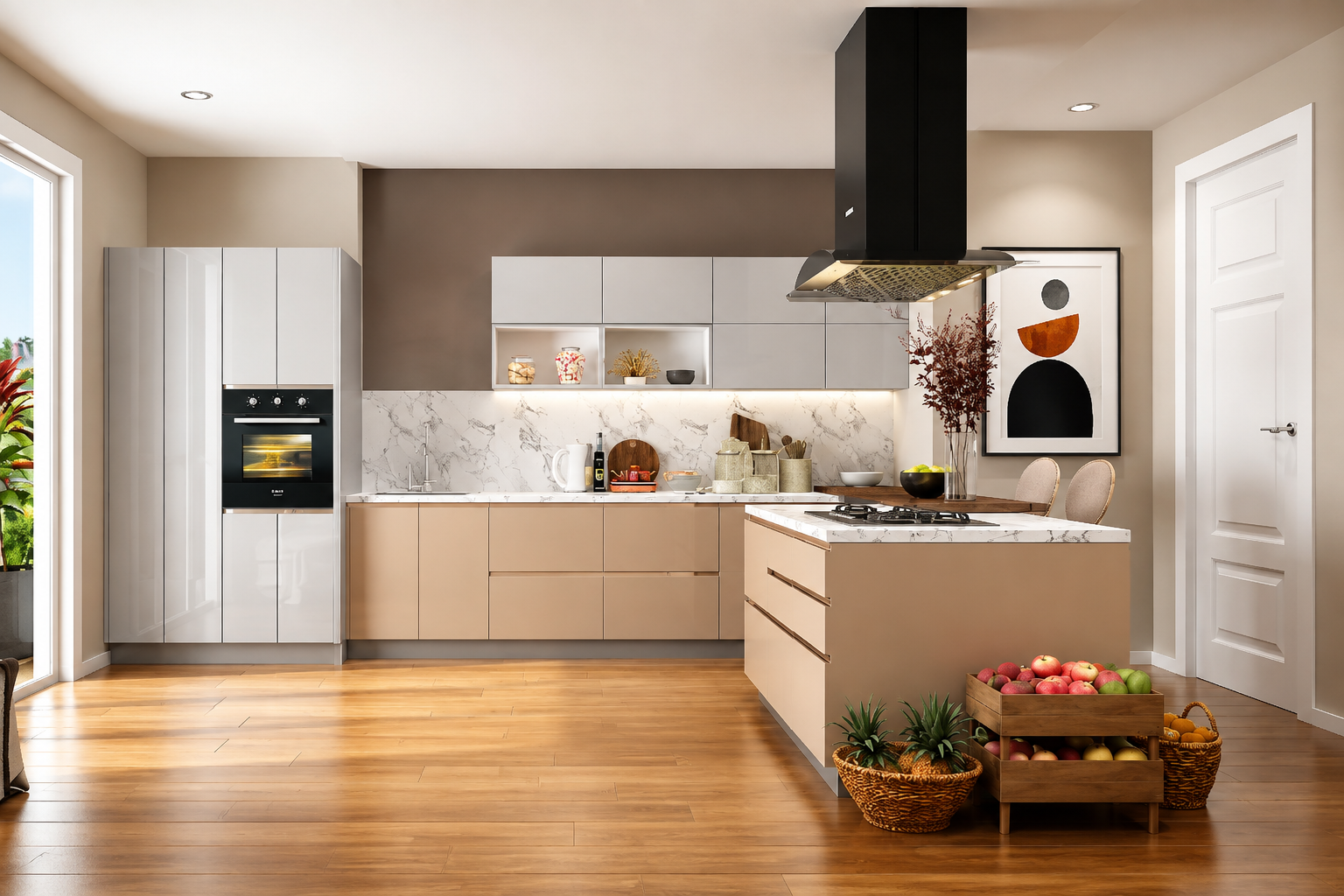
- Wider canopy for island or peninsula hobs, since open layouts need a bigger capture area
- Motion or gesture sensor controls so the chimney runs at full power exactly when needed, without greasy fingers on a switch panel
Downdraft Extractor vs Traditional Chimney: Which Wins for Indian Cooking?
For island kitchens especially, homeowners often ask us to compare a downdraft extractor vs traditional chimney.
|
Factor |
Traditional Chimney |
Downdraft Extractor |
|
Best suited for |
Wall-mounted or island hobs with visible canopy |
Sleek island setups where a hanging chimney would block sightlines |
|
Extraction efficiency for Indian cooking |
Higher — captures rising smoke and steam effectively |
Lower — smoke rises before being pulled down, so it's less effective for high-heat tempering and frying |
|
Maintenance |
Moderate |
Higher — retractable mechanisms need regular servicing |
|
Recommended for heavy Indian cooking |
Yes |
Only for light cooking; not ideal as the sole extraction source |
Our honest recommendation for most Indian households: unless your design absolutely demands a downdraft for a statement island, stick with a well-sized traditional or island chimney. It's simply more effective against the volume of smoke and oil particles that Indian cooking produces.
Why Exhaust Fans Still Matter Alongside a Chimney
Even with a powerful chimney, exhaust fans for modular kitchens placed near the cooking zone or on an adjacent wall add a valuable second layer of extraction — especially useful during frying sessions or when multiple burners are running at once. If your kitchen has an external wall, a well-placed exhaust fan combined with a slightly open window creates natural cross-ventilation that pulls residual odor out faster than a chimney working alone.
How Do You Separate a Living Room From an Open Kitchen Without Blocking Light?
Ventilation handles the air; layout handles containment. Together, they solve the odor problem without sacrificing the open feel.
Glass Partitions vs Peninsula Counters: Which Divider Works Better?
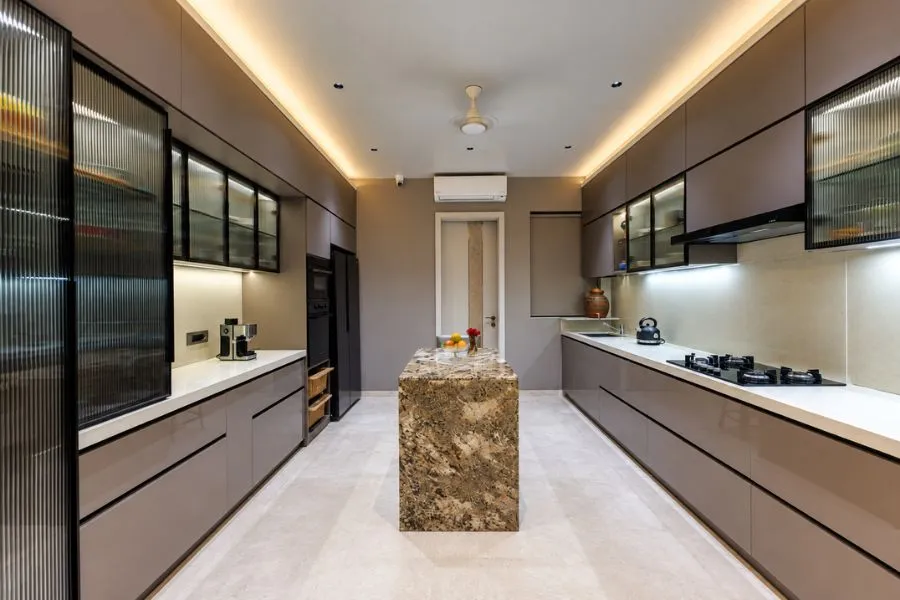
A glass partition for open kitchen design is, in our experience, the single best compromise for Indian homes. It blocks the direct spread of oil mist and steam into the living area, preserves natural light flow, and can be fitted with sliding or fold-back panels — so you can fully open the kitchen when cooking something light, and close it during heavy tempering or frying. Frosted or fluted glass adds a design statement while still doing the job of a barrier.
If a full glass partition feels too structured for your space, a peninsula counter with a raised breakfast bar creates a physical and visual break between the cooking zone and the seating area without closing anything off. It's a popular middle ground in semi open kitchen design India projects because it keeps sightlines open while adding just enough distance to slow odor spread.
Hob Placement and Ceiling Design: The Overlooked Layout Factors
Place your cooktop as far from the living/dining zone as the layout allows, and never directly in the path of airflow leading into the seating area. Pairing this with a chimney positioned correctly above the hob (not off-center) dramatically improves capture efficiency. Beyond the chimney, good modular kitchen ventilation solutions also account for:
- Ceiling height and false ceiling design — taller ceilings allow smoke to disperse upward before being extracted, rather than rolling straight into the living room
- Ducting routed to the shortest possible external exit, since long duct runs reduce real-world chimney efficiency significantly
- Materials that don't trap odor — laminate and PU-finished cabinets resist oil absorption far better than porous, untreated finishes, and are easier to wipe down after a heavy cooking session
How Do You Manage Grease, Smoke, and Air Quality Day to Day?
Even with the best hardware in place, a few daily habits go a long way toward managing grease and smoke in open layouts.
A Five-Point Daily Checklist for Odor-Free Open Kitchens
- Cook with lids on wherever possible, especially for gravies and dal — this alone significantly cuts down steam and odor release
- Switch the chimney on before you start cooking, not after the smell has already spread
- Clean chimney filters monthly if you cook daily with oil-heavy dishes — clogged filters lose suction fast
- Consider a kitchen air purification unit as a supplementary measure for very heavy-cooking households, particularly if allergies or asthma are a concern
- Keep a small standalone exhaust running for 15–20 minutes after cooking to clear out residual particles the chimney may have missed
How Do You Prevent Tadka Smell From Reaching the Living Room?
Since tempering is often the biggest single odor spike in Indian cooking, it deserves a dedicated approach.
Four Sequencing Changes That Cut Tadka Smell at the Source
- Do your tadka on the burner closest to the chimney's center, never on a corner burner
- Turn the chimney to its highest setting a few seconds before you add mustard seeds or hing to hot oil — reaction time matters
- If you have a sliding glass partition, close it during the tempering step specifically, even if the rest of your cooking happens with it open
- Keep a lid within reach to quickly cover the pan for a few seconds after adding whole spices, which controls the initial smoke burst
Small sequencing changes like these often make a bigger difference than people expect, you don't need to redesign your kitchen to see results, though pairing these habits with the right hardware gets you the best outcome.
Who Designs Custom Open Kitchens Built for Indian Cooking in Gurgaon?
An open-concept kitchen and authentic Indian cooking aren't mutually exclusive — they just require a design partner who understands both the aesthetic brief and the practical realities of how Indian families actually cook. That's exactly where Betula Kitchen comes in.
Why Homeowners Choose Betula Kitchen for Open and Semi-Open Layouts
As one of the leading modular kitchen designers in Gurgaon, we specialize in custom open kitchen designs Gurgaon homeowners can actually live with — from selecting the right high-suction chimney and appliance package to designing glass partitions, peninsulas, and ventilation-conscious layouts that keep your open kitchen looking sharp and smelling fresh. Backed by a 50,000+ sq. ft. manufacturing facility on the Dwarka Expressway and a reputation as one of the premium modular kitchen manufacturers NCR trusts, we bring both design expertise and manufacturing precision to every project.
If you're planning an open or semi-open kitchen and want a layout built specifically around how you cook, not just how it photographs, reach out to Betula Kitchen for a free consultation. Let's design a kitchen that's as functional as it is beautiful.
Conclusion
You shouldn’t have to choose between a stunning, modern open floor plan and the rich, aromatic traditions of Indian cooking. While the crackle of a tadka and the slow simmer of an oil-rich gravy present unique challenges for open layouts, they are entirely solvable with intentional design.
By equipping your home with a high-suction chimney (1400 m³/hr or higher), incorporating smart visual dividers like glass partitions or peninsulas, and adopting a few simple cooking habits, you can keep your living spaces fresh and odor-free. The goal isn't to change how you cook, but to build a kitchen that actually supports it.
An open kitchen in an Indian home isn't just an aesthetic choice; it requires a functional strategy. With the right planning and expert guidance from a specialized team like Betula Kitchen, you can finally create that bright, connected, and welcoming space—allowing you to entertain effortlessly without ever worrying about the smoke.
Frequently Asked Questions
Q1. How to stop Indian cooking smells from spreading in an open-plan house?
Focus on three layers: a high-suction chimney (1400 m³/hr or above) positioned correctly over the hob, a partial physical barrier such as a sliding glass partition or peninsula counter, and daily habits like cooking with lids on and running the chimney before smoke starts, not after.
Q2. Is an open kitchen a good idea for heavy Indian cooking?
It can be, provided you invest in strong ventilation and some form of partial separation. A fully open kitchen with a standard chimney and no barrier will struggle with heavy daily frying and tempering. A semi-open layout with a powerful chimney and a glass partition or peninsula is a much safer bet for Indian cooking habits.
Q3. What is the required chimney suction power (m³/hr) for an open kitchen?
For most Indian open-plan kitchens, aim for at least 1200–1400 m³/hr, with 1600 m³/hr or higher recommended for larger connected spaces or households that fry and temper frequently. Closed kitchens can typically get away with 1000–1200 m³/hr.
Q4. How to separate the living room from an open kitchen without blocking light?
A glass partition, clear, frosted, or fluted, is the most effective option, since it physically blocks oil mist and steam while letting light pass through freely. Sliding or folding glass panels give you the flexibility to fully open the kitchen when you're not cooking anything heavy.